The Calm Regime found that currency risk moves in regimes. Why We Must Exist showed that, once separable, each component of that risk could be allocated by price and preference, and shared by the local-currency balance sheet. The Dollar Denominator argued that the dollar can keep its unit and change its collateral, and ended at Bretton Woods, Keynes against White, with one denominator resting on many sovereign promises. This paper takes up the question that leaves open: how.
IWhat must stay home
A semi-permeable membrane is defined as much by what it keeps apart as by what it lets through.
A dollar claim resting on several sovereign bills at once must unwind each one separately, and each as cleanly as the others, if it is to come back whole. A Pakistani bill is a rupee promise under Pakistani law behind the State Bank’s convertibility rules; a Turkish bill is a lira promise under Turkish law behind the central bank in Ankara. Putting both beneath one dollar claim means keeping those differences intact. The first recycling did the opposite: it made the promise, the currency and the risk cross the border together. A borrower in Mexico City borrowed dollars from a bank in London; the liability crossed monetary systems, the currency mismatch crossed with it onto the balance sheet least able to carry it, and when Volcker raised the price of the dollar it detonated. For decades the dominant architecture for external sovereign borrowing did exactly that: change the borrower’s obligation until foreign capital could hold it, usually by denominating it in foreign currency. Economists call the underlying constraint original sin and have usually treated it as a property of countries. It may also be a property of the architecture.
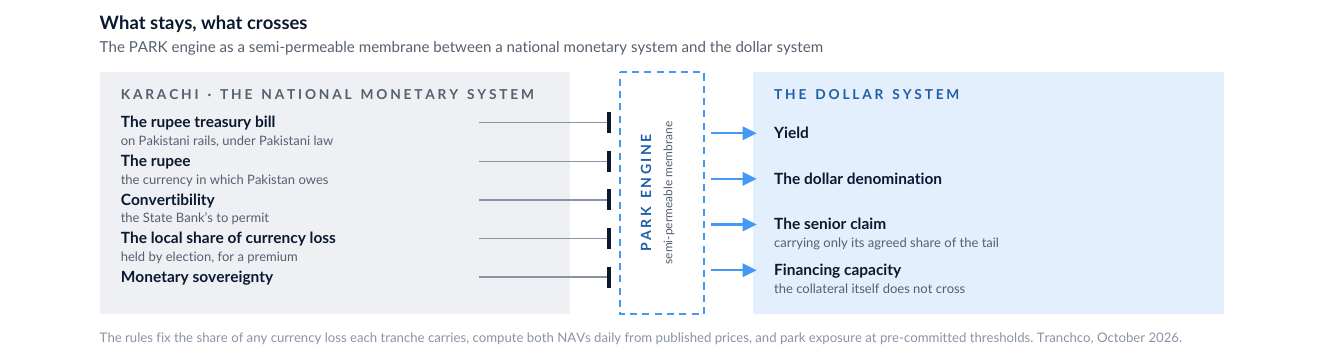
For a Pakistani bill to remain what it is, four things stay home. The bill stays in Pakistan, on Pakistani rails, under Pakistani law. The rupee stays the currency in which Pakistan owes. The State Bank keeps control of convertibility. The domestic institution that understands the rupee keeps the share of its risk it elects to hold, and is paid for holding it. None of those can travel without becoming something else. A semi-permeable membrane is built on that fact: it decides what crosses. Tranchco’s PARK engine is that membrane. Its rules fix the share of any currency loss each tranche carries, compute both NAVs daily from published prices, and park exposure at pre-committed thresholds, and an administrator holding none of the risk can reproduce every figure. Through it, yield crosses and the dollar denomination crosses. Of the currency tail, only the share the dollar holder agreed to carry crosses; the rest is allocated at home, to the balance sheet that can read it. The bill, the currency, the convertibility authority and the sovereign’s monetary authority stay where they are.
IIWhat can cross
Move the claim. Leave the risks.
What appears on the dollar side of the membrane is a claim: senior, denominated in dollars, secured on the Karachi bill, carrying its agreed share of the currency risk and no more. Pakistan has issued no dollar obligation, and yet global dollar capital funds a rupee bill. The reason is simple to state: the risks do not have to travel together. The old architecture globalised the balance sheet, and the mismatch came with it. This one globalises the claim and leaves each risk with the balance sheet that can carry it.
Pakistan continues to owe rupees; the foreign investor holds a dollar-denominated claim; the local institution holds its contracted share of the currency loss; nobody is asked to pretend those are the same risk, because the tranching keeps them apart. The currency in which a country owes and the currency in which global capital measures its claim may not have to be the same thing. If that sentence survives the pilots, what has changed is the architecture beneath original sin.
IIIDoes it move?
What the mechanism makes is a claim. Whether it is collateral is somebody else’s decision.
Separating the risks does not make the resulting claim something the international system can use. Manmohan Singh, the IMF economist (not the late Indian prime minister), gave the underlying conditions. Collateral, in his accounting, need not be highly rated; it must be liquid, marked to market daily, and movable under a master agreement that transfers title, because an asset that cannot move has a velocity of zero, however safe it is. The essential distinction is between a safe asset and a pledgeable one. On CME’s current eligible foreign-sovereign schedule the emerging-market list reaches Mexico; Pakistan’s bill, the senior claim in its own system, is outside it for want of mobility. Tranchco does not try to move that bill; it manufactures another claim against it, whose risks have been separated far enough that the claim may eventually move even though the collateral does not. Eligibility is conferred by whoever takes the collateral. Tranchco can manufacture collateral quality. It cannot declare collateral eligibility. Singh’s conditions decompose, for this instrument, into the six tests below.
| Does it move? Six tests, three instruments | US Treasury bill | Pakistani bill, in Karachi | Tranchco senior claim |
|---|---|---|---|
| Legal certaintyenforceable title transfer | global repo documentation | Pakistani law; domestic only | Structurable; undocumented |
| Daily marka price every day | the deepest market | published revaluation curve | Built; reproducible |
| Liquiditysold or repoed in size | any size, any hour | deep at home; none offshore | Unproven until it trades |
| Haircuta number history justifies | 0.5% at CME | no schedule outside Pakistan | Being evidenced; measurable |
| Standard formpledgeable onward | CSD and ICSD | domestic depository only | Structurable; not yet issued |
| Convertibilitysettles in the margin unit | it is the unit | at the holder’s risk | Exogenous; the sovereign’s |
Sources: Manmohan Singh, IMF WP/13/186; CME Group acceptable collateral schedule, 6 October 2026; Tranchco. Status of the senior claim as at publication.
Three can be engineered: legal certainty, daily valuation and standard form. Two must be earned: liquidity through trading, and a haircut from the collateral taker. The sixth, convertibility, remains the sovereign’s, and if the window closes the claim waits. The change that matters is the haircut. A raw Karachi bill bundles rates, currency, convertibility, liquidity and settlement into one exposure; the structure separates some of them, the junior takes its contracted share of currency loss, and the engine reduces exposure as the regime deteriorates. The senior therefore has what the raw offshore exposure never had, a defined loss distribution from which a collateral taker can ask what haircut would have survived a stated liquidation period at a stated confidence. The pinned Pakistan run produced a largest senior dollar NAV drawdown of 2.8 percent; Turkey, across eight years and four hard unwinds, 11.6 percent. Those are backtests, and a backtest is not a schedule. The question has become measurable, and the pilot begins turning that engineered history into an observed one.
IVAll others post
Keep White’s denominator. Take Keynes’s intuition. Leave every sovereign inside its own monetary system.
Do that once and there is a Pakistani instrument. Repeat it in Turkey, Egypt and Nigeria, and each sovereign keeps its monetary system, each issues its own currency, each domestic market prices its own tail, each domestic institution chooses how much of that risk it will take, and each bill stays on its own regulated rails. Nothing has been homogenised. Yet the senior claims can be standardised, and standardised claims can be pooled. The result is a globally standardised claim whose collateral remains nationally heterogeneous: übernational collateral. It is none of the things the twentieth century reached for: no supranational issuer, no new currency, no new central bank, no multilateral guarantee, and no second Bretton Woods. Each monetary system keeps its sovereignty; the commonality sits one layer above it, in the claim.
The bill is where the experiment begins because it is the cleanest claim in any domestic system. If currency risk can be separated, priced and governed there, the same question can be put to the rest of the balance sheet: which other locally sound assets, bank claims, receivables, trade finance, are internationally unusable only because their risks were never separated into claims the global system can hold? Currency was the wedge; risk segregation and collateral architecture are the platform.
Perry Mehrling describes money as a hierarchy, in which what serves as money at one layer is a promise from the layer above. The hypothesis here applies that logic across monetary systems. The join between them need not occur between their central banks, as it did through the Federal Reserve’s swap lines in 2008; it can occur lower down, at the level of a secured claim, and ask the apex for nothing.
The twentieth century tried to solve this at the level of money. Keynes proposed a new international unit resting on many sovereigns at once; White prevailed, and one national currency became the world’s denominator. The first recycling then made emerging countries borrow that currency too. The next architecture need not choose between those designs. It keeps White’s denominator and takes Keynes’s intuition about the many sovereigns beneath it, and instead of forcing them into one monetary system it leaves each inside its own. Their bills, their currencies and their risks remain national; only the claim is global. Keynes thought the unit had to be redesigned. Perhaps it never did; perhaps the collateral beneath it did, and putting many sovereigns beneath one unit requires no supranational issuer, only an architecture that makes their heterogeneous collateral interoperable. That is what Tranchco is building, one sovereign at a time.
Pakistan can already borrow dollars. The pilot asks whether Pakistan can keep borrowing rupees and make the resulting collateral useful to dollar capital anyway. If it cannot, the experiment ends where collateral has always ended, at the border. If it can, original sin begins to look less like a law of international finance than an engineering problem nobody had yet solved: the dominant architecture made emerging-market collateral internationally legible by changing the currency of the obligation. This one asks whether the collateral can remain national while the claim becomes global.
In God we trust; all others post collateral. They had the collateral all along. What was missing was the membrane.